Why Are My Shorts Getting No Views? 11 Fixes for Clips Cut From Long Videos
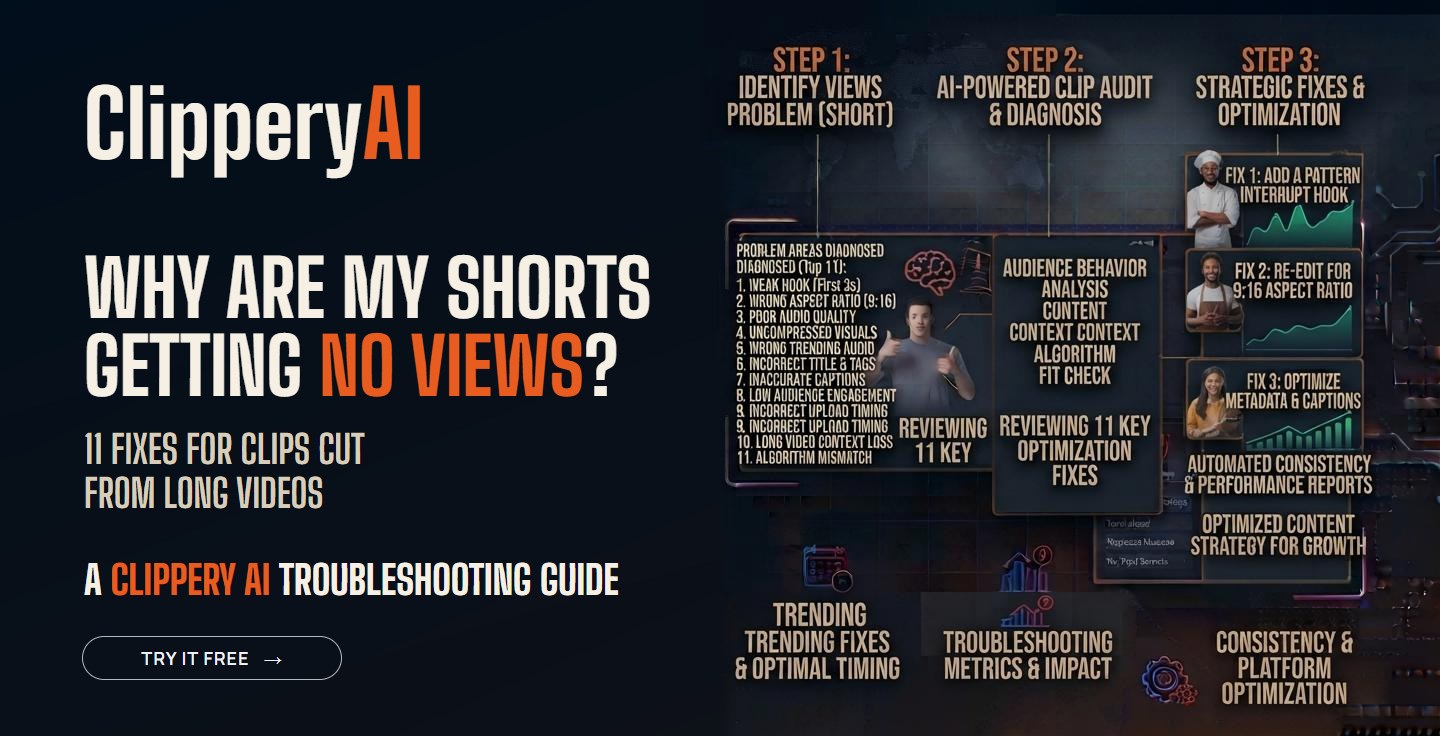
You recorded a solid podcast episode, cut it into clips, posted them, and three days later they're sitting at 40 views. It's frustrating, and it's easy to blame the algorithm. In most cases, though, the cause is something inside the clip: a slow first second, a missing caption, a speaker too small to see on a phone. Those are all things you can fix.
First, check that it's a real problem
Before you change your whole approach, rule out the simple stuff:
- Visibility settings. Make sure the video is public, not private, unlisted or scheduled for later.
- Processing. A fresh upload can take a little time before it starts getting shown. Give it a day before you worry.
- New accounts. Brand-new channels and profiles often start slowly while the platform figures out who your content is for.
- The wrong number. Views alone don't tell you much. Look at how much of each clip people watch. Our guide to short-form video metrics that matter explains how to read a retention graph.
Quick diagnosis: match your symptom to the fix
| What you see | Likely cause | Start with |
|---|---|---|
| Views stall early on almost every clip | Viewers swipe away in the first seconds | Fixes 1 and 2 |
| Decent views, but few people watch to the end | The clip runs longer than the idea | Fix 5 |
| Good watch time, but no new followers | No clear topic across your clips | Fix 10 |
| One platform works, another doesn't | Framing, text or watermark issues | Fixes 4, 6 and 8 |
| A sudden drop across all clips | Reused or unoriginal content signals | Fixes 6 and 7 |
11 reasons your clips aren't getting views (and what to do)
1. The clip starts in the wrong place
Long recordings warm up slowly. People say "so, yeah," "that's a great question," or spend twenty seconds on background before getting to the point. If your clip starts there, viewers are gone before the good part. Start on the sentence that states the idea, the claim or the problem. Our post on short-form video hooks for clips cut from long recordings covers six opening patterns you can find in unscripted footage.
2. The clip needs context nobody has
"Like I said earlier," "going back to his point," or "that's why the second one matters" all assume the viewer watched the full episode. They didn't. Either include the setup in the clip or pick a different moment. A good test: send the clip to a friend who has never heard your show. If they ask "wait, what's he talking about?" it needs work. Here's more on what makes a clip shareable.
3. There are no captions, or they're hard to read
Plenty of people scroll with the sound off, at work, on the bus, or late at night. Without captions, a talking-head clip is just a face moving its mouth. Captions also need to be readable: big enough, high contrast, and kept away from the parts of the screen covered by buttons. See our guide to captions for short-form video for styling and placement.
4. The speaker is tiny in a vertical frame
Dropping a horizontal video into a 9:16 frame with big black bars above and below makes the speaker small and the clip look like a repost. Crop or reframe so the person talking fills the screen. Here's how to convert horizontal video to vertical without losing the subject.
5. The clip is longer than the idea
A 90-second clip with 30 seconds of repetition will lose people halfway through. Every platform now allows longer uploads, but that doesn't mean every clip should use the extra time. Cut the clip when the thought is complete. Our post on how long short-form videos should be compares platform limits with the length that holds attention.
6. There's another platform's watermark on it
Downloading your TikTok and reposting it to Reels or Shorts with the TikTok logo still on it is one of the most common mistakes creators make. Platforms tend to show watermarked reposts to fewer people. Always export a clean file from your original recording and upload that to each platform.
7. The content isn't yours to post
Clipping someone else's podcast, stream or interview without permission can get your clips removed, hit with copyright claims, or limited for being unoriginal. Stick to recordings you own or have clear permission to use. Your own footage, edited with your own choices, is what platforms want to reward.
8. The text around the clip doesn't say what it's about
Titles, descriptions and on-screen text help platforms understand who should see your clip, and they help viewers decide whether to stop scrolling. "Ep. 47 clip" tells nobody anything. "Why most first-time landlords underprice rent" tells people exactly what they'll get. Use the words your audience would type into search, and add a few relevant hashtags instead of thirty random ones.
9. You post in bursts
Fifteen clips on Monday and nothing for two weeks makes it hard for any clip to get a fair shot. A steady rhythm works better than occasional floods. If you're not sure what pace is realistic, read our guide on how often to post short clips.
10. Your clips jump between unrelated topics
People follow an account when they know what they'll get next. If Monday's clip is about marketing, Tuesday's is about your dog, and Wednesday's is a hot take on sports, viewers have no reason to follow. Keep most of your clips inside two or three related topics so your account has a clear identity.
11. You're judging too early, or on only one platform
Some clips take off within hours. Others, especially on YouTube Shorts, keep picking up views for weeks. Give each clip at least a week, and test the same clip on more than one platform before you decide it failed. Each platform has a different audience, as we explain in YouTube Shorts vs TikTok vs Instagram Reels.
What won't fix low views
- Buying views or followers. Fake views don't watch, comment or share, so they can make your real numbers look worse.
- Deleting and re-uploading the same clip again and again. It rarely helps and throws away whatever data the first upload collected.
- Stuffing in trending hashtags that have nothing to do with the clip. Hashtags help with relevance, not reach on their own.
- Changing your niche every week. It resets the signal you've been building.
A 14-day reset plan
| Days | What to do |
|---|---|
| Days 1 to 2 | Pick one strong long recording. Pull 8 to 10 clips, each starting on a clear first line and each making sense alone. |
| Days 3 to 4 | Add captions, reframe for vertical, and watch every clip on your phone with the sound off. |
| Days 5 to 14 | Post one clip per day at roughly the same time, with a specific title and a few relevant hashtags. |
| Day 14 | Find your two best clips by average view duration. Write down what their openings have in common and use that on the next batch. |
How ClipperyAI helps with the most common causes
Several of the problems above come from how clips are cut, and that's the part ClipperyAI handles. You upload a recording or paste a link to your own video, and it finds moments that hold a complete thought, trims them, reframes them around the speaker, adds word-timed captions that stay inside the frame, and adds a hook. When a clip needs earlier setup to make sense, it pulls that context in. Clips come from across the whole recording, not just the first ten minutes. It works only with your own footage and doesn't generate synthetic video or voices, so what you post stays original. See how ClipperyAI works.
Key takeaways
- Low views on clips usually trace back to the clip itself: the opening, the context, the captions or the framing.
- Start every clip on the line that states the point, and make sure it makes sense without the full episode.
- Export clean files with no watermarks, and only post content you own or have permission to use.
- Post on a steady schedule and give each clip at least a week before judging it.
- Judge clips by how much people watch, not just by view count.
Frequently asked questions
Why does my YouTube Short have 0 views?
Check that it's public and finish processing first. If it's live and still at zero after a day, the most common reasons are a brand-new channel, a clip flagged as reused content, or a watermark from another app. Upload a clean original file and keep posting consistently.
Should I delete a Short that got no views?
Usually not. Old clips can pick up views later, and deleting them doesn't help new ones. If a clip has a real problem, like a wrong fact, fix it by posting a corrected version and then remove the old one.
How long does it take for a Short to start getting views?
It varies. Some clips get most of their views on the first day, while others grow slowly for weeks. Give each clip at least seven days before deciding how it performed.
Do hashtags help Shorts get more views?
A few relevant hashtags can help platforms understand your topic. They won't save a clip with a weak opening, and dozens of unrelated tags don't help at all.
Can I post the same clip on TikTok, Reels and Shorts?
Yes, as long as you upload a clean file without another platform's watermark. Write a separate title or caption for each platform so it fits how people search and scroll there.