What Makes a Video Clip Shareable? How to Find the Best Moments in a Long Recording
Anyone who has tried to clip their own podcast knows the feeling. You remember a part that felt amazing in the room. You cut it, post it, and it gets twelve views. Then a throwaway line you almost deleted takes off.
There's a pattern behind which moments travel and which don't. Once you know what to look for, you'll find better clips faster, whether you're scrubbing a timeline yourself or reviewing suggestions from a tool.
What makes a video clip shareable?
A video clip is shareable when it delivers a complete idea or reaction in a short time and gives the viewer a reason to send it to someone else: it teaches them something, says what they think, surprises them or makes them laugh. Completeness is the part most people miss.
The 3 parts of a clip that works
Almost every clip that performs well has three parts, even if they happen in 30 seconds:
- The hook. The opening line that makes someone stop scrolling. A bold claim, a question, or the start of a story.
- The body. The minimum context needed to understand the point.
- The payoff. The punchline, the answer, the result or the takeaway. Without it, the viewer feels cheated.
If a moment has a great hook but no payoff, skip it. If it has a great payoff but needs two minutes of setup, look for a shorter way into it.
7 types of moments that make great clips
1. The contrarian opinion
"Everyone tells you to post every day. I think that's bad advice." Opinions that push against common wisdom get comments, shares and saves, because people want to agree or argue.
2. The surprising fact or number
A specific, unexpected detail makes people stop. "We spent $40,000 on ads and got two customers" is more clip-worthy than "ads didn't work for us."
3. The quick framework
A simple list or step-by-step method explained in under a minute. These get saved and shared because they're useful.
4. The personal story
A short story with a turn in it, like a failure, a lucky break or an awkward moment, builds connection faster than any explanation.
5. The funny exchange
Natural humor between hosts or guests travels well. It doesn't need to teach anything; it needs to land.
6. The direct answer to a common question
If your audience keeps asking something, the moment you answer it clearly is a clip. These also do well in search on YouTube.
7. The emotional peak
Moments where someone gets visibly passionate, moved or frustrated feel real. Viewers respond to genuine reactions.
For gaming and streams, the moments look different: clutch plays, fails, chat reactions. Our guide on making Twitch highlights covers those.
Moments that usually don't work as clips
- Inside jokes that need the whole episode for context
- Long setups where the point arrives after a minute
- Sponsor reads and housekeeping
- Answers that start with "Well, it depends..." and never commit
- Moments that only work with a visual the camera didn't capture
How to find the best moments faster
The fastest way to find clip-worthy moments is to search for signals: changes in energy, laughter, strong words like "never" or "the biggest mistake," questions from a guest or audience, and spots where you remember thinking "that's a good point."
- Read the transcript. Skimming text is faster than watching video. Look for short, punchy paragraphs.
- Mark moments while recording. Note the timestamp when something good happens.
- Ask your co-host or guest. They often remember the strongest moments.
- Check comments on the full episode. Viewers will tell you which parts they liked.
- Look across the whole recording. The best moments are rarely all in the first 15 minutes.
How ClipperyAI chooses moments
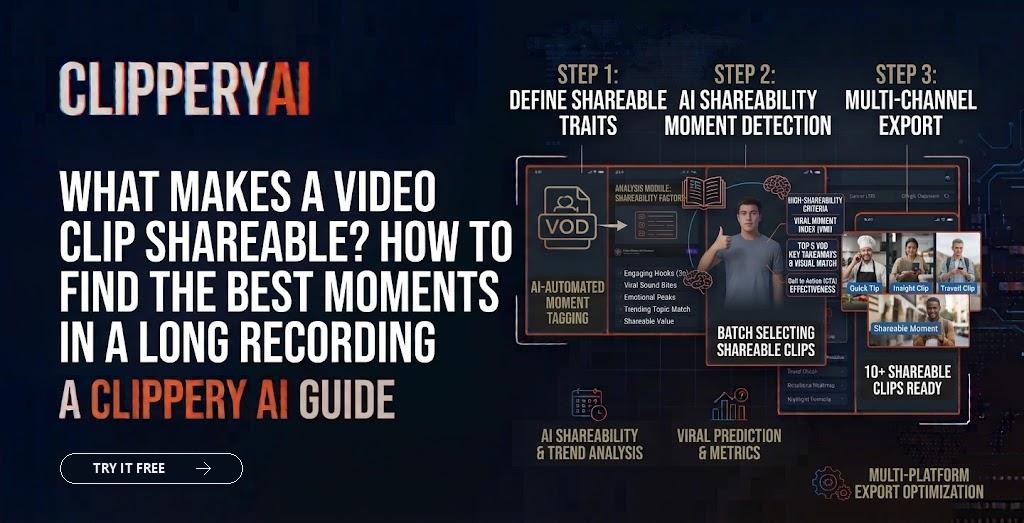
ClipperyAI looks for complete moments with a clear beginning and payoff, rather than random 30-second chunks. When a clip needs a little context to make sense, it keeps that context. It also spreads clips across the whole recording so you don't get ten versions of the same section. You review the suggestions and pick what to export. See how it works or read the FAQ. Podcaster? Start with our podcast clips page and the full guide to making podcast clips.
Key takeaways
- Shareable clips are complete: hook, minimal context, payoff.
- Strong opinions, surprising facts, quick frameworks and short stories clip best.
- Skip moments that need too much context or never reach a point.
- Use transcripts, timestamps and energy changes to find moments faster.
Frequently asked questions
How do I know if a clip will go viral?
Nobody can promise that. You can improve the odds by choosing complete moments with a strong opening line and a clear payoff, and by posting consistently so more clips get a chance.
How important are the first 3 seconds of a clip?
Very. On short-form feeds, viewers decide almost instantly whether to keep watching. Start the clip on the most interesting line, not on a greeting or filler.
Should I add context text at the start of a clip?
A short on-screen line can help when the clip needs a bit of setup, such as naming the guest or the topic. Keep it brief so it doesn't cover the speaker or captions.
How many clips should I post per episode?
Post as many as you have strong moments for. Many creators share three to ten clips per episode spread over the following week or two.